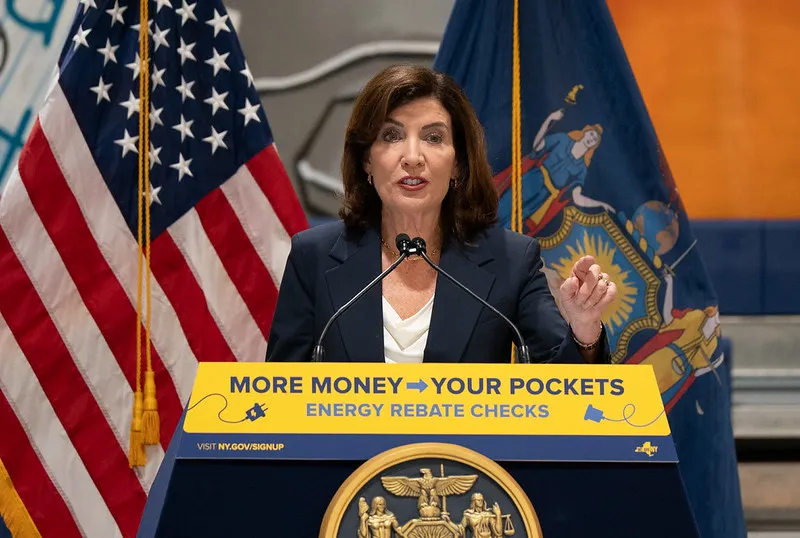

New York Gov. Kathy Hochul is preparing to send $100 to $200 utility rebate checks to 8.2 million New Yorkers as the 2026 election approaches. The NYC energy rebate checks are part of the state’s $1 billion Protecting Our Wallets Energy Rebate (POWER) program, which was included in the 2026-27 state budget. According to a report by City & State New York, the checks are scheduled to begin arriving in September and October.
What Happened
Hochul announced September 14 that New York would begin mailing POWER checks the following week.
The program covers New York residents earning $300,000 or less annually. The checks are part of the state budget enacted in May and are intended to provide relief from rising utility costs.
According to the New York State Assembly, the enacted budget allocated $1 billion for POWER checks benefiting approximately 8.2 million New Yorkers. The amounts are based on filing status and income reported on 2024 tax returns.
The payment structure is:
- Joint filers earning below $150,000: $200
- Joint filers earning between $150,000 and $300,000: $150
- Single filers earning below $150,000: $100
The checks are scheduled to be distributed between September and December.
Why the Timing Is Drawing Attention
The payments are being distributed shortly before the November 2026 elections, when Hochul is seeking reelection.
City & State reported that the approximate September and October timing had previously been reported by Gothamist. The exact mailing schedule was not disclosed when the state budget was enacted.
Hochul’s office says the timing is connected to the operational capacity of the state Department of Taxation and Finance rather than the election calendar. According to the explanation reported by City & State, the agency has additional capacity for direct rebate programs when it pauses some work related to the School Tax Relief program.
The distinction matters because the same timing can be viewed differently depending on whether the focus is on administrative scheduling or election-year politics.
A Second Round of Direct Payments
The POWER checks follow another statewide payment program from 2025.
Last year, Hochul’s administration sent inflation refund checks worth up to $400 to the same broad group of approximately 8.2 million New Yorkers.
Those payments used surplus state tax revenue and became part of Hochul’s affordability messaging.
The 2026 program is different in origin. City & State reported that the POWER checks originated as an Assembly proposal rather than as part of Hochul’s original executive budget proposal.
The Assembly initially proposed payments of up to $500 per household, with a projected $2.6 billion cost and a smaller eligible population. The final budget adopted a $1 billion program covering approximately 8.2 million people.
Hochul and Trump’s Different Check Proposals
The rebate program has also become part of a political debate involving President Donald Trump.
Trump has proposed sending $5,000 checks to every adult American if Republicans maintain control of the U.S. House, according to City & State’s report.
Hochul criticized that proposal, describing it as a campaign incentive.
Her administration argues that New York’s POWER checks are different because they were authorized through the state budget as an energy-affordability program.
The comparison has therefore become part of the broader political debate over direct payments, affordability policy and election-year messaging.
Previous Criticism of Hochul’s Checks
Hochul’s 2025 inflation refund program faced criticism from some state lawmakers and fiscal watchdogs.
Critics questioned whether relatively small payments distributed to millions of residents represented the most effective use of state funds.
During the 2025 budget negotiations, some state senators proposed narrowing the eligible population to seniors so that larger payments could go to fewer recipients.
That proposal did not prevail.
State Sen. James Skoufis also introduced legislation that would have prevented the governor’s name or image from appearing on the checks.
The legislation did not advance. Hochul’s office said her signature was not placed on last year’s checks and will not appear on this year’s POWER checks.
Why This Matters for NYC Candidates
The NYC energy rebate checks offer a useful case study for candidates considering how to run for office in NYC.
Direct government benefits can become important campaign issues because voters experience them personally. But candidates need to distinguish between an existing government program, campaign messaging about that program and the legal authority of the office they are seeking.
Understand Which Government Controls the Program
The POWER program is a New York State initiative, not a City Council program.
That distinction is important for first-time candidates.
A City Council candidate cannot independently create or change a statewide rebate program. The candidate should instead understand which state agencies administer the program and what authority local government has over related affordability issues.
The Assembly identifies the state budget as the source of the $1 billion POWER program, while City & State reported that the Department of Taxation and Finance is responsible for administering the rebate checks.
Campaign Messaging Around Affordability
Affordability is often a central issue in NYC elections.
Candidates may discuss utility bills, housing costs, food prices, transportation and taxes. But campaign messaging should distinguish between policies already enacted and proposals a candidate intends to pursue.
For example, a City Council candidate discussing energy affordability could explain what City Hall can influence while acknowledging that state and federal governments control other components of utility policy.
That makes campaign messaging more precise and easier for voters to evaluate.
District Strategy and Voter Data
A statewide benefit may affect residents across many districts, but the political relevance can differ by neighborhood.
Candidates can use available voter data and demographic information to understand the economic characteristics of their district. They can then combine that information with direct conversations with residents.
The goal is not simply to identify whether voters support an affordability policy. Candidates should understand which costs residents identify as most important and which government level can address them.
Campaign Finance and Public Benefits
The timing of government payments can also create campaign-finance questions for candidates.
Candidates should clearly distinguish government communications from campaign communications.
A government agency distributing an authorized benefit is different from a campaign using that benefit as part of political advertising.
Candidates participating in NYC’s public matching-funds program should also ensure that their campaign communications and expenditures comply with Campaign Finance Board requirements.
Ballot Access Still Matters
Affordability messaging does not replace the basic requirements for running for office.
A prospective City Council candidate still needs to understand:
- Eligibility requirements
- Petition and ballot-access rules
- Filing deadlines
- Campaign-finance registration
- Contribution and expenditure rules
- Public matching-funds requirements, if applicable
A strong campaign platform needs to operate alongside compliant campaign infrastructure.
What First-Time Candidates Can Learn
The rebate debate illustrates several practical campaign lessons.
Separate Policy From Political Timing
Candidates should be able to explain when a program was authorized, who proposed it, which agency administers it and when payments are scheduled.
That information provides a stronger foundation than simply describing a payment as an election-year benefit.
Research the Budget Behind a Program
The POWER program demonstrates why candidates should examine budget documents before discussing government spending.
The original Assembly proposal differed from the final program in both the size of individual payments and the number of eligible residents.
Understanding that legislative history can help candidates explain how negotiations changed a policy before it became law.
Avoid Overpromising
Candidates should also understand the limits of their office.
A City Council candidate can campaign on local affordability policies, but statewide rebate programs require state-level action.
Clearly identifying those boundaries can help first-time candidates develop realistic policy platforms.
What Happens Next
The state will begin mailing POWER checks in September, with the overall distribution scheduled to continue through December. Approximately 8.2 million New Yorkers are eligible under the program, with payments determined by filing status and income.
The payments will arrive as New York heads toward the November 2026 elections, making affordability and the use of public funds likely to remain part of political discussion.
For NYC candidates, the broader lesson is that government programs can become campaign issues even when they are controlled by another level of government. Candidates need to understand the policy itself, the budget and agency responsible for it, the voters affected by it and the distinction between government action and campaign messaging.
The POWER program therefore provides a practical example of why successful local campaigns require more than a compelling message. Candidates also need accurate policy research, district strategy, voter data and a clear understanding of government authority.
Related Reading
NYC Releases 170,000 Pages of 9/11 Documents
NY-19 Race: GOP Pulls Support From Oberacker
FAQs
Approximately 8.2 million full-time New York residents qualify based on income and filing status reported on their 2024 tax returns.
Eligible single filers earning below $150,000 receive $100, while eligible joint filers receive $150 or $200 depending on household income.



[…] NYC Energy Rebate Checks Head to 8.2 Million New Yorkers […]