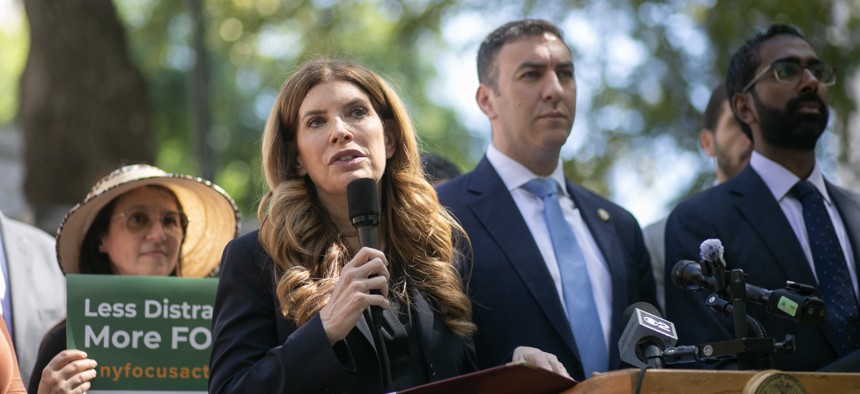

The New York City Council is preparing a major NYC AI hearing on October 5, 2026, with Speaker Julie Menin asking OpenAI and Anthropic to participate in a rare Committee of the Whole session. The hearing will examine AI safety, misuse, oversight and potential safeguards for New Yorkers, creating a new policy issue for NYC politics and candidates to understand.
According to a report by City & State New York, Menin told both companies that the Council “invites and expects” them to participate in the October hearing. OpenAI and Anthropic both have offices in New York City and retain city lobbying firms.
What Happened?
The full 51-member City Council will convene as a Committee of the Whole to examine the risks and potential benefits associated with rapidly advancing artificial intelligence.
The format is unusual. According to City & State, the Council’s last recorded Committee of the Whole session was in 2022, when members examined the city’s provision of services to migrants.
The October 5 hearing is expected to examine questions including:
- AI safety and potential risks
- How AI systems are being developed and deployed
- Potential misuse by bad actors
- Existing safeguards and oversight
- Whether additional city legislation or regulation may be appropriate
- The potential effects of AI on public safety and economic stability
The official City Council announcement similarly says the hearing will examine existing safeguards and potential legislative or regulatory action to protect New Yorkers.
Why Are OpenAI and Anthropic Being Asked to Participate?
Speaker Menin sent letters to OpenAI CEO Sam Altman and Anthropic CEO Dario Amodei requesting their participation.
The companies have a direct presence in New York City, and City & State reported that each has retained lobbying representation in the city. OpenAI is represented by Bolton-St. Johns, while Anthropic has CMW Strategies and London House.
The Council’s interest comes as governments face questions about whether existing laws and safeguards are sufficient for increasingly capable AI systems.
The official Council announcement said the hearing is intended to investigate the risks posed by rapidly advancing AI and examine whether additional safeguards are needed.
What Powers Does the NYC Council Have Over AI?
The hearing does not mean the City Council has unlimited authority over AI companies or frontier AI models.
City & State noted that the Council may have relatively limited power to regulate these companies directly, particularly where AI policy intersects with state or federal jurisdiction.
That distinction is important for candidates and policymakers.
A City Council member can introduce and vote on local legislation, participate in oversight and use the Council’s legislative and investigative functions. But not every technology policy question can be resolved through city legislation.
For candidates, understanding which level of government has authority over an issue is an important part of developing a realistic policy platform.
Why This NYC AI Hearing Matters for NYC Candidates
Technology policy is increasingly relevant to city government.
AI can affect consumer services, employment, education, public safety, government operations and business activity. That means candidates running for City Council may eventually need to explain how they would approach AI-related issues within the city’s legal authority.
The hearing provides several practical lessons for people considering a run for office in NYC.
Understand the Government’s Actual Authority
A candidate should distinguish between issues controlled by City Hall, the New York State government and the federal government.
For example, a City Council campaign discussing AI regulation should identify which specific practices could potentially be addressed through local legislation and which require state or federal action.
This prevents campaign messaging from promising powers that the office does not actually possess.
Build Campaign Messaging Around Specific Policies
AI is a broad subject.
A candidate could discuss data privacy, automated decision-making, consumer protection, employment, public-sector technology or AI safety. Each involves different policy questions.
First-time candidates can therefore benefit from turning a broad technology issue into specific, understandable policy proposals.
Instead of simply saying that AI needs to be “regulated,” a campaign should explain what conduct it wants government to address and what authority would be used.
Use Voter Data to Understand Local Concerns
Technology policy may not be equally important to every neighborhood.
A City Council campaign can use voter data, district research, community meetings and direct conversations with residents to determine which technology-related issues have practical relevance locally.
For example, one district may have stronger concerns about employment and automation, while another may focus more on consumer privacy or the use of AI by city agencies.
The campaign message should reflect the actual concerns of the district rather than treating AI as a single citywide issue.
Campaign Finance and AI Policy
The AI debate also intersects with campaign finance and political communications.
Candidates increasingly use digital tools to create campaign content, analyze audiences and communicate with voters. As AI tools become more capable, campaigns may need to consider questions involving transparency, accuracy, privacy and responsible use.
Candidates should also separate their campaign’s use of technology from the policy questions surrounding commercial AI companies.
Campaign finance compliance remains necessary regardless of which digital tools a campaign uses. Technology can support fundraising, voter outreach and campaign operations, but it does not replace the legal requirements governing political committees and expenditures.
Ballot Access Comes Before Technology Strategy
For anyone considering running for office in NYC, technology policy is only one part of campaign preparation.
Before developing a sophisticated digital strategy, candidates need to establish the basic campaign infrastructure:
- Confirm eligibility for the office.
- Understand ballot access and petition requirements.
- Meet filing deadlines.
- Establish the appropriate campaign committee.
- Understand campaign finance and matching-fund requirements.
- Research the district and voter data.
- Develop policy positions and campaign messaging.
- Build voter outreach operations.
The NYC AI hearing illustrates how a policy issue can become relevant to a campaign, but candidates still need to complete the basic requirements for getting onto the ballot and operating a compliant campaign.
AI Oversight and NYC Politics
The Council’s decision to hold a full-body hearing gives AI a more visible place in NYC politics.
Menin has emphasized both sides of the technology debate. The official Council announcement says AI can contribute to innovation, economic growth, scientific discovery and improvements in consumer and business services, while also raising concerns about public safety, security and economic stability.
That creates a policy challenge for candidates: discussing potential risks without overlooking the potential uses and benefits of the technology.
For campaigns, the broader lesson is that emerging policy issues often require more precise messaging than traditional political topics.
The Council’s Broader Oversight Role
The AI hearing also demonstrates how City Council members can use oversight as part of their elected responsibilities.
A Council hearing can bring government officials, companies, experts, advocates and other stakeholders into a public policy discussion. It can also help Council members gather information before considering legislation.
The official Council announcement says the October hearing will examine current safeguards and determine whether additional legislative or regulatory measures may be appropriate.
For prospective candidates, this provides an example of how elected officials can influence policy even when they do not have unilateral authority over an issue.
What NYC Candidates Can Learn
The NYC AI hearing offers several broader lessons for people preparing to run for office.
First, understand jurisdiction. Candidates should know what city government can and cannot regulate.
Second, turn broad issues into specific policies. AI is a large subject, so campaigns need clear definitions and concrete proposals.
Third, research the electorate. Voter data and direct community engagement can help determine which technology issues matter locally.
Fourth, understand oversight. Legislative work is not limited to voting on bills; hearings and investigations can also inform policymaking.
Finally, connect policy to implementation. Candidates should be prepared to explain how a proposed policy would work in practice, what agency or government body would administer it and what authority would support it.
What Happens Next?
The NYC Council is scheduled to hold the Committee of the Whole hearing on October 5, 2026. Menin has requested participation from OpenAI and Anthropic, although the companies’ participation remains a matter for the hearing process.
The Council will examine AI safety, existing safeguards and potential legislative or regulatory responses available to New York City.
For NYC candidates, the broader significance is that technology policy is becoming part of the local government conversation. Candidates preparing to run for office can use emerging issues such as AI to develop a more detailed understanding of city authority, voter concerns, campaign messaging and policy implementation.
Related Reading
NYC PAC: Menin Launches Statewide PAC for Democrats
NYC Creates Office Focused on Worker Rights
FAQs
The NYC Council’s Committee of the Whole hearing is scheduled for October 5, 2026.
The Council plans to examine AI risks, existing safeguards and whether additional local legislative or regulatory measures are needed.




[…] NYC Council Calls OpenAI and Anthropic to AI Hearing […]
[…] NYC Council Calls OpenAI and Anthropic to AI Hearing […]