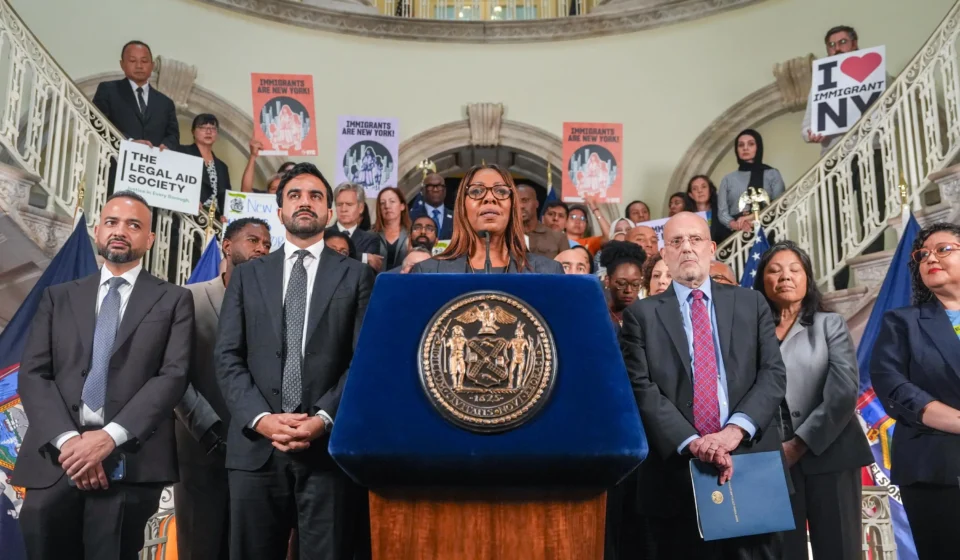

New York City is leading a coalition of cities and counties in a legal challenge to a new federal “public charge” rule. The rule could affect how immigration officials review certain visa and green card applications. The NYC public charge lawsuit was filed in Manhattan federal court on September 14, 2026. Mayor Zohran Mamdani and other local officials are asking the court to block the rule before it takes effect on September 18.
According to a report by NY1, the lawsuit challenges the federal government’s decision to expand the types of public benefits that immigration officials can consider when reviewing certain applications.
What Happened
New York City, Chicago, San Francisco, Santa Clara County, Seattle, King County and the Public Rights Project filed the lawsuit in the U.S. District Court for the Southern District of New York.
The case targets a Department of Homeland Security rule that expands how immigration officials can consider certain means-tested or income-based public benefits.
The federal government published the rule in July. It is scheduled to take effect on September 18, 2026.
Meanwhile, New York Attorney General Letitia James filed a separate lawsuit with a coalition of states and the District of Columbia.
Both lawsuits ask the courts to stop the new rule from taking effect.
What Is the Public Charge Rule?
“Public charge” is a term in federal immigration law. Officials use it when they assess whether certain people seeking admission or adjustment of status may become primarily dependent on government assistance.
Under the new rule, immigration officials would have more discretion to consider an applicant’s use of certain public benefits.
These benefits can include programs such as Medicaid, SNAP and some housing or food assistance, according to reporting and government statements.
The NYC lawsuit argues that the new approach goes beyond the historical understanding of the public-charge standard. It also argues that the rule gives immigration officers broad discretion without clear enough limits.
The federal government takes a different position. DHS says the policy reinforces the requirement that immigrants should be able to support themselves.
The courts will now consider these competing legal arguments.
Why Is New York City Challenging the Rule?
NYC officials say the rule could discourage immigrant families from using public programs, even when they legally qualify for those programs.
The city also argues that uncertainty could affect people who are not directly subject to a public-charge assessment.
For example, some families may avoid public services because they worry about possible immigration consequences in the future.
The city’s legal filing also argues that the federal government exceeded its authority by expanding the definition and application of “public charge.”
DHS disputes that position and says the rule supports existing immigration requirements.
The federal court process will determine how those arguments are addressed.
Two Lawsuits From New York
New York has two separate legal challenges against the same federal rule.
New York City-Led Lawsuit
Mayor Mamdani’s administration is leading the municipal coalition.
The participating governments include:
- New York City
- Chicago
- San Francisco
- Santa Clara County
- Seattle
- King County
The Public Rights Project is also part of the coalition.
The city argues that the rule could create uncertainty for immigrant communities and local governments. It also challenges the broader federal discretion that the rule gives immigration officials.
New York State Lawsuit
Attorney General Letitia James is leading a separate coalition of 21 other states and the District of Columbia.
That lawsuit also challenges the expanded public-charge policy. It argues that the federal government exceeded its legal authority.
Although the two cases are separate, both challenge the same federal rule. Both also seek to prevent the policy from taking effect.
What Officials and Advocates Are Saying
Mayor Mamdani has said the rule could discourage immigrant families from using health, food and other assistance programs.
Attorney General James has similarly argued that the policy changes the longstanding understanding of public charge.
Meanwhile, immigration organizations have warned about a potential “chilling effect.” This term describes a situation where people avoid using benefits because they fear future immigration consequences, even when they remain legally eligible.
The federal government has offered a different interpretation. DHS says the rule reinforces the requirement that immigrants should be able to support themselves.
As a result, the legal dispute involves both the meaning of the public-charge standard and the federal government’s authority to change its application.
Why This Matters for NYC Candidates
The NYC public charge lawsuit provides a useful case study for people considering running for office in NYC.
Immigration policy often involves multiple levels of government. A City Council candidate may campaign on issues affecting immigrant communities, but federal agencies control many immigration decisions.
Understanding that division of authority can help candidates develop more accurate campaign messaging.
Know Which Level of Government Has Authority
A City Council campaign should distinguish between:
- Federal immigration enforcement and visa policy
- New York State legal actions
- NYC programs and services
- Community organizations that provide legal or social assistance
Most importantly, candidates should avoid promising changes that their office cannot make.
Instead, a campaign can explain what city government can actually do. That could include providing local services, coordinating outreach or supporting residents affected by federal policies.
District Strategy and Immigrant Communities
Immigration policy can affect NYC neighborhoods in different ways.
Therefore, a City Council candidate developing a district strategy should research the communities within the district.
Useful information can include:
- District demographics
- Publicly available voter data
- Local service providers
- Community organizations
- Previous election results
- Local policy concerns
However, data should not replace direct engagement.
Community meetings, canvassing and conversations with residents can reveal concerns that demographic or voter data cannot show.
Campaign Messaging
The public charge debate also shows why campaign messaging needs to separate facts from political arguments.
Candidates discussing immigration should identify the specific policy under debate. They should also explain which government controls that policy.
In addition, candidates should distinguish documented legal requirements from claims made by political actors or advocacy organizations.
This approach can help first-time candidates explain complex federal policies without overstating what local government can change.
Campaign Finance and Political Advocacy
Immigration policy can also become part of campaign fundraising, endorsements and political communications.
However, candidates should distinguish government activity from campaign activity.
Campaign finance rules still apply to fundraising, spending and political communications. This remains true even when a campaign discusses a major federal policy issue.
Candidates who participate in NYC’s public matching-funds system must also follow the applicable Campaign Finance Board requirements.
Ballot Access Still Comes First
A major federal policy dispute does not change the basic requirements for running for local office.
Candidates considering a City Council campaign still need to understand eligibility rules, petition requirements, filing deadlines and campaign finance registration.
A practical preparation process can include:
- Identify the office and district.
- Confirm eligibility.
- Research ballot-access and petition requirements.
- Establish the required campaign finance structure.
- Study district demographics and voter data.
- Identify major local issues.
- Develop messaging based on the office’s actual responsibilities.
The public charge dispute shows why understanding government authority should be part of this preparation.
What Could the Lawsuit Mean for Local Government?
The case could affect local governments because they administer or help residents access many public services.
NYC officials argue that uncertainty around the federal rule could reduce participation in some programs. They also say it could create additional challenges for local agencies and community organizations.
The federal government maintains that the rule reinforces immigration requirements related to self-sufficiency.
Ultimately, the courts will decide whether the federal government can implement the rule as written.
What Happens Next?
The new public charge rule is scheduled to take effect on September 18, 2026.
However, the NYC-led lawsuit and the separate state-led lawsuit are asking the courts to intervene before or as the rule takes effect.
As the cases move forward, the courts will consider the legal challenges to the Department of Homeland Security’s rule.
For NYC candidates, the broader lesson is straightforward: local campaigns often intersect with state and federal policy.
Candidates need to understand who controls an issue, how that policy affects their district and what their office can realistically do.
The NYC public charge lawsuit therefore offers more than an immigration-policy case study. It also shows how federal policy can become a local campaign issue involving voter concerns, government services, coalition-building, public communication and district strategy.
Related Reading
Hochul Tries to Hold the Center as New York Politics Shifts
NYC Expands Free Lead Pipe Replacement Program
FAQs
It is a federal lawsuit led by New York City and other local governments challenging a new DHS rule that expands how public benefits may be considered in certain immigration decisions.
The rule is scheduled to take effect on September 18, 2026, while separate lawsuits led by New York City and Attorney General Letitia James challenge the policy.



[…] NYC Public Charge Lawsuit Challenges Trump Immigration Rule […]
[…] NYC Public Charge Lawsuit Challenges Trump Immigration Rule […]