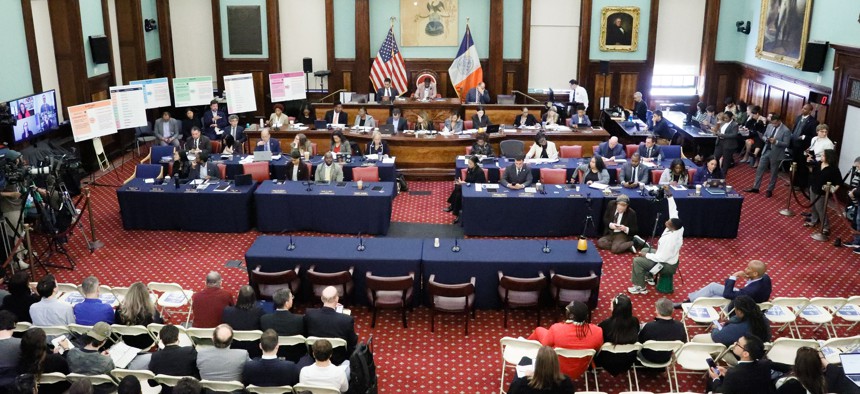

Several New York City Council members submitted statements flagged as AI-generated when responding to questions about affordable housing. According to City & State New York, the findings raise questions about how elected officials use artificial intelligence in public communications.
AI Detection Flags Seven Council Members’ Statements
City & State contacted 29 City Council members about the city’s Affordable Housing Fast Track list and received 18 responses. The publication screened the statements it planned to quote using Pangram, an AI-detection tool.
Seven responses were flagged as entirely AI-generated or as a mix of AI-generated and AI-assisted writing. Three statements, from Frank Morano, Mercedes Narcisse and Shahana Hanif, were classified as 100% AI-generated.
Council Members Give Different Explanations
Some officials acknowledged using AI, while others denied generating their statements with the technology. Morano said he used AI to draft or refine responses but maintained that the views expressed were his own.
A spokesperson for Hanif said her office initially drafted its response before using AI to shorten and refine it. Narcisse said a former fellow had prepared the flagged response, while she used AI for research.
Others Dispute the AI Findings
Phil Wong’s chief of staff said the office used AI only for grammar checks. Chris Banks also denied using AI to generate his response, saying the technology was used to check grammar.
Farah Louis’ team denied using AI and suggested the result was a false positive. City & State noted that Pangram is an imperfect tool, meaning its classifications should not be treated as definitive proof of AI use.
AI Use Is Becoming a Broader Political Issue
The findings come as New York officials debate how artificial intelligence should be used and regulated. Some elected officials have also used AI to research unfamiliar subjects, analyze large documents and help prepare written material.
However, AI detection tools cannot conclusively establish who wrote a statement. The responses show why transparency about AI use matters when officials communicate with the public.
What NYC Candidates Can Learn About Public Communication
People considering running for office in NYC should ensure that public statements accurately reflect their own positions. AI can help with editing and research, but candidates remain responsible for checking facts and approving what they publish.
Clear, authentic communication helps voters understand a candidate’s views. The debate over AI-generated statements highlights the importance of accuracy, transparency and personal accountability in political campaigns.
Related Reading
- NYC Comptroller Mark Levine Reconsiders Israel Bonds Campaign Pledge
- Mamdani Faces Questions on Housing and NYCHA Repairs
Yes. Pangram flagged seven of 18 responses reviewed by City & State as entirely AI-generated or a mix of AI-generated and AI-assisted writing.
No. AI detection tools can produce inaccurate results, so a classification alone does not prove that a statement was generated by AI.