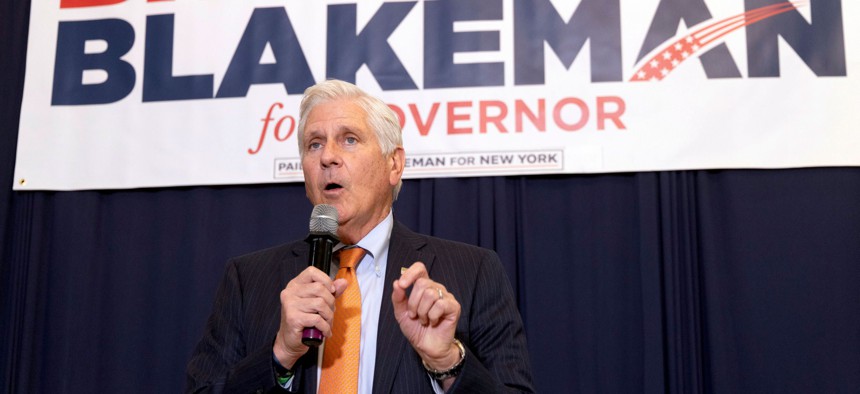

A newly formed super PAC supporting Republican gubernatorial candidate Bruce Blakeman could reshape the financial dynamics of New York’s 2026 governor’s race. According to a report by New York Focus, the independent expenditure committee “Make it Cheaper” was created to support Blakeman’s campaign as he seeks to close a substantial fundraising gap with Democratic Governor Kathy Hochul ahead of the November election.
The development highlights the growing role of outside spending in statewide campaigns and offers important lessons for candidates running for office across New York, including those seeking local office in New York City.
What Happened
Republican candidate Bruce Blakeman, currently serving as Nassau County Executive, has struggled to match Governor Kathy Hochul’s fundraising strength.
Campaign finance records showed that Hochul held a significant cash advantage entering 2026, with more than $20 million reported in campaign funds compared to approximately $1.6 million for Blakeman earlier this year.
The formation of the Make it Cheaper super PAC provides Blakeman with a potential source of outside support that can raise and spend unlimited amounts of money independently of his campaign.
The committee is being managed by political operatives with experience in previous statewide Republican campaigns, including individuals who worked on independent expenditure efforts supporting former Congressman Lee Zeldin during the 2022 governor’s race.
Key Details About the New Super PAC
Who Is Behind the Committee?
State records show that Kristofer Graham is serving as treasurer of the new committee. Graham previously held the same role for a super PAC that spent more than $7 million supporting Lee Zeldin’s 2022 gubernatorial campaign.
Republican consultant Chris Grant of Big Dog Strategies is also reportedly involved in the effort.
Why the Name “Make it Cheaper”?
While the committee has not publicly outlined its full strategy, the name suggests a focus on affordability and cost of living concerns, issues that continue to rank highly among New York voters.
Affordability has become a central theme in many campaigns across New York, including races involving housing costs, taxes, transportation expenses, and economic development.
How Super PACs Operate
Independent expenditure committees can raise and spend unlimited sums of money to support or oppose candidates.
However, state election law prohibits these organizations from coordinating directly with the campaigns they support.
This distinction is one of the most important principles in campaign finance regulation and frequently becomes a focus of scrutiny during competitive elections.
Lessons From the 2022 Governor’s Race
Outside spending played a significant role in New York’s 2022 gubernatorial election.
Several independent expenditure committees spent millions supporting Republican nominee Lee Zeldin, helping make the race more competitive than many observers expected.
The election also generated legal and regulatory scrutiny regarding alleged coordination between campaigns and super PACs. State election authorities ultimately reached a substantial settlement with groups involved in the investigation, although no admission of wrongdoing was included in the agreement.
The experience serves as a reminder that while super PACs can influence elections, compliance with campaign finance rules remains essential.
Why This Matters for NYC Candidates
The emergence of the Make it Cheaper super PAC provides important campaign lessons for anyone interested in running for office in New York City.
Campaign Finance Shapes Competitive Elections
Even candidates who participate in public matching funds programs may find themselves competing in races influenced by outside spending.
Understanding how independent expenditures work can help candidates anticipate messaging campaigns, advertising efforts, and voter outreach funded by outside organizations.
Fundraising Remains Critical
A strong campaign treasury allows candidates to communicate directly with voters and maintain control over their message.
Candidates who rely solely on outside support may have less influence over how their campaign is perceived by the public.
Messaging Matters
The focus on affordability demonstrates how campaigns often build narratives around issues that resonate broadly with voters.
Successful candidates typically connect policy priorities with concerns that directly affect constituents’ daily lives.
Voter Targeting and District Strategy Are Essential
While statewide races receive significant media attention, local candidates must still identify and mobilize supporters through direct voter engagement.
Strong voter data analysis, district strategy, and community outreach often determine whether campaigns succeed in competitive environments.
Candidates should also understand campaign finance regulations and voter targeting strategies before launching a campaign.
Potential Impact Beyond the Governor’s Race
Political strategists have long argued that strong performance at the top of the ticket can influence down ballot races.
During the 2022 election cycle, Republican gains in several congressional districts helped the party regain control of the U.S. House of Representatives.
Some observers believe a well-funded gubernatorial campaign could similarly affect voter turnout and candidate performance in congressional, legislative, and local races throughout New York.
What Happens Next
The Make it Cheaper super PAC is expected to begin fundraising and spending activities as the general election approaches.
Observers will be watching closely to see how much money the committee raises, what issues it emphasizes, and whether it can help narrow the financial gap between Blakeman and Hochul.
The race may also provide additional insight into how independent expenditures continue to influence modern elections in New York.
Conclusion
The formation of a new super PAC supporting Bruce Blakeman underscores the growing importance of outside spending in New York politics. While fundraising advantages remain important, independent expenditure committees can significantly shape campaign messaging and voter outreach efforts. For aspiring candidates, the development serves as a valuable case study in campaign finance, political strategy, and the realities of running competitive campaigns in today’s electoral environment.
It is an independent expenditure committee formed to support Republican gubernatorial candidate Bruce Blakeman in the 2026 New York governor’s race.
No. State election laws prohibit candidates and campaigns from coordinating directly with independent expenditure committees.